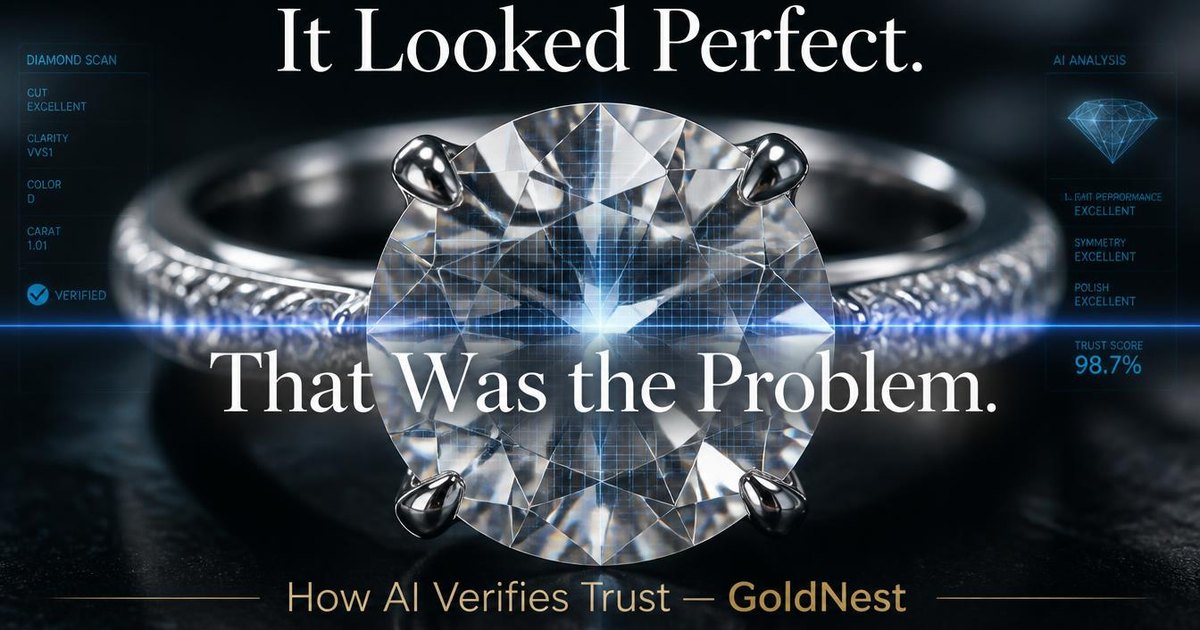
The Diamond Looked Perfect. That Was the Problem.
Lab-grown and natural diamonds are now chemically and visually identical. That's exactly why AI has quietly become the most important tool in a jeweler's shop — not for design, but for trust.
A customer walks into a shop in Dubai and picks up a ring. The stone is bright, clean, beautifully cut. She asks the one question every jeweler now has to answer with total confidence: is this natural?
Ten years ago, an experienced gemologist could often tell just by looking closely, using a loupe and years of trained instinct. Today, that's no longer reliable. A lab-grown diamond has the same chemical composition, the same crystal structure, the same fire and brilliance as one pulled from the earth. The eye simply can't tell the difference anymore. And that's not a flaw in lab-grown diamonds — it's the entire point of them.
So the question shifted. It's no longer "can a person tell?" It's "can we prove it, reliably, every single time?" That's the exact problem AI has stepped in to solve — quietly, without much fanfare, in gem labs and jewelry shops around the world.
01 — The Real ProblemWhy the Human Eye Stopped Being Enough
Natural, HPHT-grown, and CVD-grown diamonds form under genuinely different conditions. Each process leaves behind faint growth-related traces — patterns invisible to the naked eye, but detectable with the right instruments. The trouble is that as lab-grown production has matured, those traces have become harder and harder to spot, even under a microscope.
This isn't a hypothetical concern for retailers. Diamond jewelry authentication specialists have been blunt about it: undisclosed lab-grown stones mixed into natural diamond inventory is one of the most serious risks the industry faces right now, and regulators expect jewelers to catch it — not customers.
That's the quiet pressure sitting behind every diamond counter today. A jeweler isn't just selling a stone. They're vouching for its origin, in writing, to a customer who has no way of checking it themselves.
02 — What ChangedHow AI Actually Does the Checking
AI-powered gem identification doesn't replace the gemologist — it gives them a second, faster, far more consistent pair of eyes. These systems analyze spectral properties, chemical signatures, and physical characteristics that are simply too subtle for manual inspection to catch reliably, every time, at scale.
Major gem labs now process millions of diamond grading reports a year, and a growing share of them are pre-screened by AI before a human gemologist ever picks up a loupe. That doesn't mean less human judgment — it means human expertise gets pointed at the cases that genuinely need it, instead of being spread thin across routine checks.
03 — A Turning PointWhat Happened in October 2025
One of the clearest signs that this shift is now permanent came from the top of the industry itself. GIA — the most respected grading authority in the world — changed how it grades lab-grown diamonds.
The message underneath that change is simple: the industry has accepted that natural and lab-grown diamonds now need to be treated, described, and verified as genuinely separate things — not because one is worse, but because a customer paying natural-diamond prices deserves absolute certainty about what they're buying.
04 — Beyond DiamondsThe Same Technology Is Reshaping the Whole Counter
Diamond verification is the sharpest example, but it's not the only place AI has settled in. Across the jewelry business, the pattern is the same: AI takes on the repetitive, detail-heavy work that used to eat up a jeweler's time, so the human parts of the job — advising, designing, building trust face to face — get more attention, not less.
- Manual gemstone inspection under a loupe, one stone at a time
- Slow, inconsistent supply chain paperwork checks
- Generic product descriptions written by hand for every listing
- Customer FAQs answered one by one, repeatedly
- Pre-screening stones by spectral signature before manual review
- Flagging treatment history — heating, irradiation, oiling — automatically
- Drafting consistent, accurate website and catalogue content in minutes
- Handling routine customer questions instantly, any time of day
None of this replaces the jeweler. The in-store relationship — someone explaining a stone, helping a customer choose, standing behind what they sell — can't be automated, and nobody serious in the industry is trying to automate it. What AI has actually done is quietly remove the outdated digital habits that used to slow independent jewelers down: the hours spent writing product copy, the inconsistent answers to the same five customer questions, the guesswork in checking a stone's history.
05 — What This Means for YouIf You Run an Independent Jewelry Business
You don't need a gem lab's budget to benefit from any of this. The practical shift for most independent and family-run jewelers isn't buying spectral analysis equipment — it's making sure the parts of your business that customers actually interact with are as clear, fast, and consistent as the big names they compare you to.
That means a customer asking about a stone gets an accurate answer immediately, not a guess. It means your online listings are consistent and complete, instead of half-written because nobody had time. It means the trust you've built in person extends to every touchpoint before a customer even walks through your door.
The businesses winning right now aren't necessarily the ones with the most advanced lab equipment. They're the ones where every customer interaction — online or in person — reflects the same level of care and accuracy the owner brings to the counter.
FAQCommon Questions
The stone hasn't changed. What's changed is how confidently we can now prove what it is.